-
Education in 2050
Education remains a vital part of our lives. It shapes us into who we are, and prepares us for the world ahead. Naturally, it has evolved constantly throughout the years, and signs show it will continue to do so. Previously, I considered how the progression of artificial intelligence will likely shape our education system by the time we reach 2040. Now, I must look further ahead to 2050. Once again drawing from curated research, along with Wendell Bell’s theory, I intend to provide a full picture of how AI might transform both our teaching methods and equity in learning.
Like before, Bell’s theory will allow me to structure this blog around multiple futures – the possible, probable, and preferable outcomes. This framework has often been identified as crucial for examinations of the future – a way to explore what could happen, what is likely to happen, and what we want to happen (1).
Possible Futures
I’ll begin where I did before – with the open end the future will always be. Already, we’re seeing AI being developed to a level beyond our wildest dreams. With that in mind, many possibilities have been considered for 2040 – ranging from AI teachers to even independent learning. The amount of ideas brimming all point to a 2040 that will be steeped in experimentation. By 2050, these innovations will have become deeply embedded in our school systems.
With the presence of fully developed AI tutors, opportunities to close ever-widening gaps will present themselves. Each student could have their tutor tailored specifically to their needs – thus allowing individualised pacing and support. Students could learn at their own pace, with AI assistants answering questions on demand and adapting content to each learning style (2).
It has been predicted that teachers will remain an integral part of the process, only they will take on more of a mentor role. Grading and exam monitoring are fully automated in this scenario – allowing teachers to form stronger connections with students and act more as guides.
This environment gives way to the closing of the equity gap, as AI’s ever-growing grasp would have the potential to reach areas where the less fortunate are plentiful.
With every student receiving personalised learning, research has shown there’s a chance to improve overall student performance by 98%. These possibilities coalesce to predict a utopian future, where learning environments are led by smart tools which put the students’ experience first. In other words, we can see an expansion continuing from what has been predicted for 2040.
Prompt 1: Possible futures of education
The AI-generated images above depict two possibilities – one that reflects the potential benefits that tech-driven learning could bring, and one that portrays more of a dystopia. In this future, human teachers have been completely replaced with AI, something experts have already advised strongly against. Furthermore, the atmosphere is sterile – thus suggesting a learning environment that is less AI and more robotic. It points to fears regarding total surveillance and biased algorithms, possibilities that would work against the idea of progress.
Naturally, the possibilities are endless. Alongside an image of warmth is another that could easily drain it.
Probable Futures
This is where I explore the outcomes that are mostly likely to occur – a space in which many of the possibilities may intertwine.
A widely projected issue happens to be one we’re already attempting to deal with – that being overpopulation. It has been predicted that, by 2050, the world will need to educate two billion more individuals than it does today. The challenge of meeting this demand will likely require AI-driven innovation – the kind of which will have already been developed as early as 2040. What is most probable is the prospect of AI-human teacher collaboration, as opposed to a full AI replacement. By 2050, the probable future is that AI will be as commonplace in schools as whiteboards and textbooks, functioning as an assistant to the teachers.
This dynamic will grant teachers more time and energy to focus on meaningful one-on-one interactions – guiding project work and nurturing social skills. In the meantime, the AI will provide organisation and grading, and even generate lesson plans (2).
According to experts, we’re likely to see regular evaluations integrated into learning software to consistently track comprehension and adjust lessons accordingly. If so, we’ll certainly see improvements in educational equity. However, the ability for these upgrades to spread worldwide will depend on policy and investment – inequality won’t vanish automatically.
Prompt 2: Probable future of education
The image above depicts our probable future – one in which both AI and human learning will intertwine. Students are benefitting from personalisation, all while still being guided and grounded by human educators.
Preferable Futures
Lastly, there’s the future that would benefit us the most. In a perfect world, AI would be harnessed thoughtfully to ensure an education that is both inclusive and of high quality. It could become a great equaliser – a tool used to bridge regional gaps.
It has been predicted that, by 2050, a global network of AI-driven learning platforms could deliver personalised lessons in any language. Already, we’ve seen attempts to solve this divide through the Internet – AI is the next natural step.
In a perfect world, classrooms remain human-centric. AI is a supportive tool, one that should assist with the collaboration, ethical reasoning, and imagination that makes us human. The focus of the AI should be on gauging student progress in a way that is fair and tailored to the needs of each student. These programs should cater to students with disabilities and different learning styles – thus bridging whatever gaps the teacher fails to fill, and leaving them to focus on the more hands-on learning.
Prompt 3: Preferable future of education
The image above presents the preferable future of education – one where human teaching remains at the centre of the process. The AI element works to complement the teaching, as both an assistant and as a translator. The image presents a future that has passed the experimentation phase that 2040 will be – thus becoming the inclusive utopia we all dreamed of.
Well, ideally anyway.
With the right ethical frameworks and reform, this future could become not only preferable, but also projected.
It would seem the key for developers is to prioritise equity, as it would ensure access to quality education for all. More than anything else, a human perspective must remain at the centre of each program.
References
(1) Angeura, C, Santisteban, A. (2016) Images of the Future: Perspectives of Students From Barcelona, Journal of Futures Studies
(2) B-Lessons Academy (2023) How AI might impact education from now to 2050, linkedin https://www.linkedin.com/pulse/how-ai-might-impact-education-from-now-2050-b-lessons-academy/
ALL IMAGES WERE CREATED WITH CHATGPT IMAGE GENERATOR
-
Arrival (2016): A Unique View on Death

https://www.thesymbolicworld.com/content/arrival-exodus-the-sci-fi-films-hidden-framework
Upon watching Denis Villeneuve’s Arrival for the first time, it surprised me. I was a teenager, waiting eagerly to find out how the alien invasion tropes would be subverted.
They were – far beyond my imagination.
After now having rewatched it, I was able to soak in further Villeneuve’s depiction of the life cycle. He manages to craft a film that feels so huge and yet so intimate.
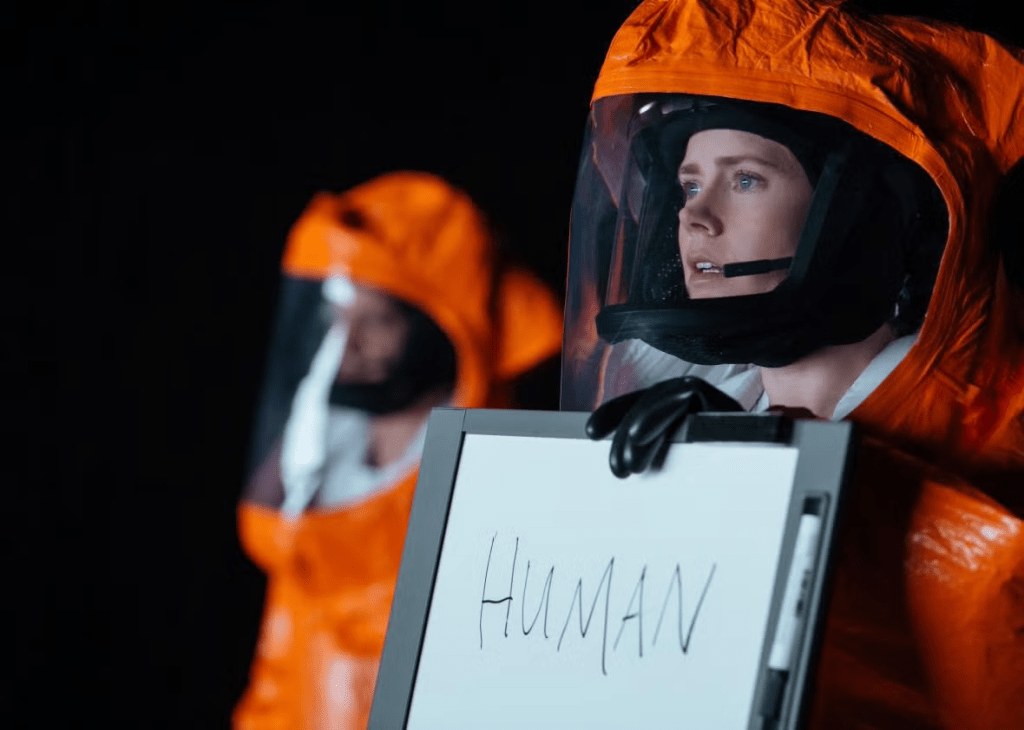
From the beginning, and even in-between her extraordinary interactions with the alien creatures, Louise (played by Amy Adams) remains haunted by visions – ones that we’re led to assume have already happened. We see flashes of her daughter – happy memories which all lead to a tragic death. The film subtly portrays the emotional burden these visions place on her – the sense of loneliness in her life is palpable.
In his article explaining the film, G.G. Townsend eloquently lays out what distinguishes Arrival from other films about alien invasion. While this trope is typically used as a symbol for a topical social issue, Villeneuve uses it to explore some of our deepest fears. This sentiment is emphasised further by James Slattery: ‘Arrival sits uncomfortably in strict generic categories, because it uses them to particularly smart effect’. He also makes the argument that the film both ‘includes’ and ‘rejects a plethora of tropes’ (1, 2020). The unique tropes creep up on the viewer, despite Louise asking quite plainly “what is your purpose on earth?” early on.
https://slate.com/culture/2016/11/all-your-arrival-plot-questions-explained.html
As is common with the sci-fi genre, Arrival experiments with the concept of time. Only the filmmakers choose to take it to a level more philosophically inclined. The questions posed ask us to turn away from the stars and enjoy life while we can. Alas, the fear of death prevents this.
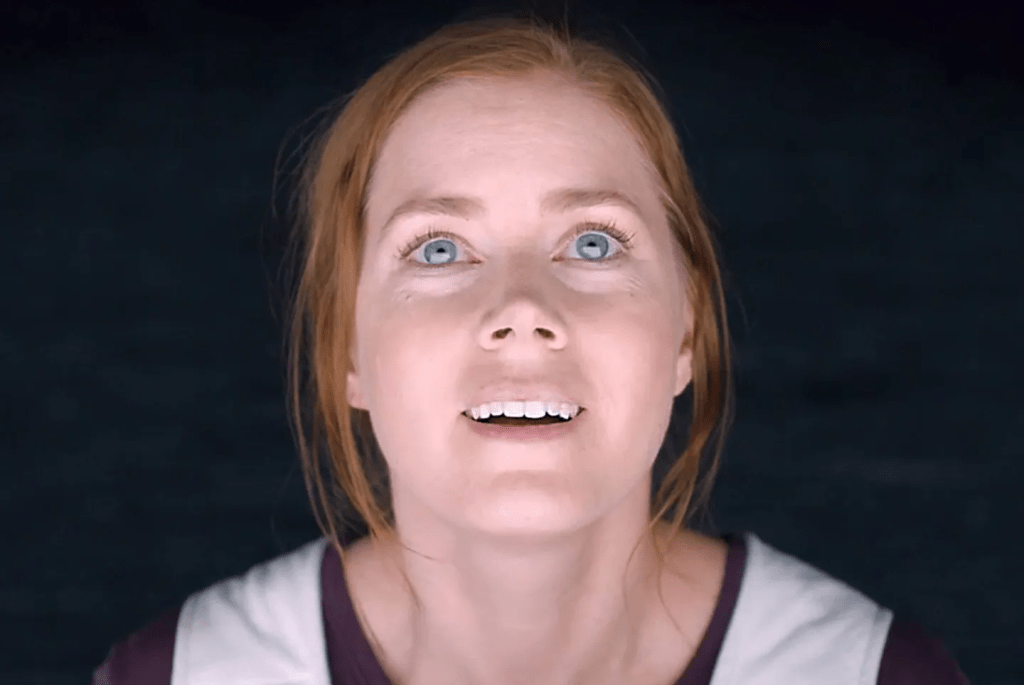
These fears are not only reflected in Louise, but also in the characters around her. As Louise fulfills her task of communicating with the ‘heptapod’ aliens, global pressure mounts. The government naturally sees these creatures as a security risk. They’re focused less on understanding them, and more on removing the potential danger they pose. Louise often runs into conflict with Colonel Weber (Forest Whitaker) as a result of this tension. This storyline sees the film follow a common trope associated with the alien invasion genre. But more than that, it highlights a fear of death that permeates throughout civilization.
https://www.vox.com/culture/2016/11/11/13587262/arrival-movie-review-amy-adams-denis-villeneuve
Louise remains on shaky ground with her employers as she grows closer with the heptapods. In her efforts to communicate with and understand them, Louise finds acceptance within herself.
The realisation that her flashbacks have actually been visions of the future functions as the film’s primary twist, as it recontextualises the entire narrative. It’s where the film reveals that this story of aliens coming to earth merely provides the backdrop for a highly personal journey. Through her experiences with the creatures, Louise captures a full picture of her life – the love, the fun, the peace, and the eventual loss. She comes to accept what once haunted her – “despite knowing the journey… and where it leads… I embrace it”. Even as she hugs the man whom she knows will leave her, she chooses to “welcome every minute of it”.
The aliens depart peacefully, thus preventing an inevitable war. In the face of these otherworldly events, Louise remains focused on a key question: “if you could see your whole life from start to finish, would you change things?”. She fully accepts that her visions are of the future. She sees the light in them, and the darkness. She lets it all unfold, for she believes the light will shine brighter. The inevitability of death doesn’t disrupt it, for it is also part of it.
A film that depicts a potential threat to civilisation ends with an individual accepting the natural life cycle. She moves on, in spite of all that transpired. The beauty of life’s narrative transcends the common alien tropes – thus resulting in a piece of art steeped in humanity.
If nothing else, Arrival remains a poignant take on the concept of our future – one that left me both rattled and in awe at once. The rewatch allowed me to soak in the nuance, for much like Louise, I knew where it was heading.
Reference
(1) Slattery, J. (2020) A Matter of Life and Death: Cinematic Necropolitics in ‘Arrival’, Free Associations, pg. 1
-
EDUCATION IN 2040
It would appear that artificial intelligence has advanced dramatically in recent years, with the introduction of softwares such as ChatGPT and GenAI. Among the sectors that have been affected (for better or worse), education remains a defining one thus far. The ethics surrounding its use in learning continues to encourage debate. All that can be safely argued is one thing: the technology isn’t going away. Drawing on research, along with both past and current discussions, this post seeks to uncover just how much further this technology could evolve by the time 2040 rolls around. The research will mainly concern past innovations and predictions, and will be supported and portrayed through use of AI generated imagery.
The structure will revolve around Wendell Bell’s framework of possible, probable and preferable futures. Bell was a futurist who approached it as “something to be shaped according to human values” rather than social trends (1, Teich). His framework functions not only as a platform to forecast both possible and probable futures, but also to decide what he sees as the ideal future (or preferable).
Possible Futures
This section will be based on the open end that, at the end of the day, the future truly is. It would seem that the most popular view is held by those who are already condemning the recent embrace of ChatGPT. In spite of the inspiration and assistance it’s known to provide, many fear that increased evolution will lead to a world in which young adults are unable to think for themselves – that they’ll be governed by information steeped in bias
What has often been discussed on both sides is the possibility of teachers being replaced by artificial intelligence, or at least partially. This could also fall into students becoming self-taught in a way. Already, there exists a wide variety of prototypes that are slowly proving the effectiveness of AI assistance. Whether it be small tasks, such as management and grading, or even fulfilling the teaching role entirely, the blueprint is there. In this scenario, teachers may then be redefined as ‘facilitators’.
We could also see a shift towards educational environments that are inclusive and more willing to adapt. There’s an estimated possibility that, by 2040, 50% of all learning management systems will be enhanced by a certain degree of AI. The concept of AI tutors has already been realised through indirect ways (such as ChatGPT), thus leaving the door open for further expansion. This would allow a greater chance for each student’s needs to be met (e.g. preferred style and pace). It would also eradicate the distance barrier – an enhancement that has already begun with the introduction of the internet. Going as far back as the early stages of remote learning (2020), certain optimists made the suggestion that AI-driven platforms could assist in closing the global education gap in the near future.
As well as positive ideas, there is also a growing fear that AI’s reign will only increase the divide that the internet has maintained thus far. There’s still a possibility that only the wealthy will be experiencing the advantages of AI learning, while impoverished communities remain left behind. Countering this would require strict policy, but still remains a possible future.
Image 1: Possible future of education (crafted by ChatGPT)
Probable Futures
With possibility, there also lies probability – based mainly on current trajectory rather than hypotheticals.
As it stands, it would appear most likely that teachers and AI will be working hand-in-hand, with AI providing administrative assistance while teachers focus on one-on-one interactions. The shift toward more adaptive and data-informed teaching methods would appear to be imminent, with the above 50% prediction remaining both a possibility and a high likelihood.
What we’re already seeing now is a mix of hands-on and AI-based learning (with this Communications and Media degree being a prime example). With this in mind, we’re seeing a clear trend toward creating guidelines that ensure safe and ethical interactions with AI moving forward.
The image below is a demonstration of how a classroom may potentially look with all of these factors considered. Although it’s not entirely dissimilar from the possible future, a main distinction would be the emphasis on one-on-one teaching that has been trajected remain (alongside the technological innovations to come).
Image 2: Probable future of education (crafted by ChatGPT)
Preferable Futures
What comes last is what would be the best possible future. Not every possibility presented thus far has been deemed positive. What we’re mainly aiming for is a collection of bridges- each tailored to fill whatever gaps we’re still currently experiencing. The idea of AI-powered learning becoming, at the very least, universally accessible, would allow a preferable vision of 2040 to be possible. Each and every individual should be able to receive an equal amount of access to this technology… in a perfect world.
The same goes for access to the physical spaces. By having AI present to lighten the load, the focus will still remain on human interaction. That way, each student can remain grounded while still feeling comfortable enough to chase their own learning goals (as set by either the AI software or the people around them). Also, teachers are given more time to hone in on personal growth rather than grading and general maintenance.
Image 3: Preferable future of education (crafted by ChatGPT)
Although there still remain potential downsides to the continued development of AI technology, they’re countered with opportunity. Experts continue to insist that “ignoring AI tools and their advances would not lead to a better understanding among students and would hinder improvements to higher education” (2, Neumann). With close monitoring and thoughtful policy-making, there’s potential brimming for the future of education. One aspect that tends to overlap across all three futures is the concept of outreach – something that began with the internet, and shall continue to be developed. Most signs seem to point to a future in which technology is used to enhance our understanding of the world, instead of making it smaller.
References
(1) Teich, A. (1997) Foundations of Future Studies: Human Science for a New Era by Wendell Bell, Isis, Vol. 8, No. 3, p.g. 520
(2) Neumann, M , Rauschenberger, M , Schön, E. (2023) “We Need To Talk About ChatGPT”: The Future of AI and Higher Education, IEEE
(all three images were created using ChatGPT image generator)
-
AI and Humanity in film
Whether it be in the blankness of space or (shudder) our dating scene, the future doesn’t appear to be promising less bleakness. The work of filmmakers Stanley Kubrick and Spike Jonze both present a world that contains all of these attributes.
Throughout our live screening of Kubrick’s 2001: A Space Odyssey (1968), I found myself taken by the grandness of it all – the vision depicts a world far beyond what I would assume would be considered feasible in the 1960s. Sixty years on, many of the fears Kubrick would predict have become eerily real. The attempts his world makes to increase efficiency and progress ends in a piece of artificial intelligence, trying all it can to evoke a living, breathing organism.
The third section of the film follows much of the aforementioned grandness, and promptly strips it away. The presence of the Hal 9000 works only to make the cold of space feel frozen over. The future is here, and is trying all it can to emulate humanity. Even after all the destruction Hal leaves in his wake, he does all he can to die painfully. As he’s slowly dysfunctioned, no music can be heard – just his increasingly low-pitched cries droning away. The emotional monologue he delivers in his signature robotic voice does nothing to attain sympathy – it’s merely a final, glaring reminder of how terrifying this technology could become.
Image 1: Hal-900 from 2001: A Space Odyssey (1968)
Michaels, S (2024). The Tragic Reason HAL 9000 Malfunctioned in 2001: A Space Odyssey May Surprise Fans, CBR, https://www.cbr.com/2001-a-space-odyssey-hal-9000-betrayal-explained/
In his essay on 2001: A Space Odyssey, Metekohy concludes that the devotion we have towards the tools we invent will lead to us losing the “authenticity of being human” (1). This idea remains prevalent in Spike Jonze’s Her (2013). It follows a lonely man wrecked with grief. Like with everybody else in this world, he finds solace in artificial intelligence. He forms a connection with a robot, once again trying to simulate a human. The universe Jonze portrays is very much our’s, but it also manages to heavily evoke the dead of Kubrick’s space.
There’s innovation in every corner, interacted with by individuals trying all they can to believe it’s authentic. Theodore spends the film doing all he can to not believe that he’s simply numbing the pain – that his relationship with his operating system is real. Alas, not even their shared sexual experiences could prevent me as a viewer from seeing through the simulation. Samantha is programmed to fulfill his needs – meaning that she is not making active choices to be with him. Theodore learns this the hard way, once he discovers that she is talking to other people at the same time – fulfilling their needs as they request. In his analysis of the film, Troy Jollimore notes that if “the program has no experiences, then it would be a mistake to attribute feelings, emotions, or any other forms of consciousness to it” (2). He goes on to claim that experience is “entirely necessary for actual love”. Theodore learns this as he reconnects with his lonely friend Amy. Despite not being romantic, the moment they share on the city rooftop in the film’s final frame signifies hope – an embrace of human connection over innovation.
Image 2: Closing frame from Her (2013)
Noble, V (2024). Scenes that Stick: final scene of ‘Her’ shows growing need for humanity in a technology-dominated world, the Eagle https://www.theeagleonline.com/article/2024/11/scenes-that-stick-final-scene-of-her-shows-growing-need-for-humanity-in-a-technology-dominated-world
I came out of both films feeling both empty and hopeful. However lifeless and foreboding Kubrick and Jonze both chose to portray the futuristic technology – what still remains is a dose of humanity. We’re still trying, still discovering – still finding ways to survive. They bring the dangers of AI to task, and predict just how little they’ll allow us to evolve in the end.
References
(1) Metekohy, Marschall Eirence (2017). The Ideology Of Being A Being In 2001: A Space Odyssey. Yogyakarta: English Language Studies of Graduate Program, Santa Dharma University
(2) Jollimore, T (2015). “The Endless Space between the Words”: The Limits of Love in Spike Jonze’s Her. Midwest Studies in Philosophy, p.g. 123 -
The Birth of Art Rock: Final Report
For my Digital Artefact, I sought to present a persona who wished to increase their knowledge in the topic of 1960s Rock music. Through this persona, I could convey my interest in this genre by sharing with an audience the ways in which this era of music remains both important and relevant to the eras that followed. Later on, I summarised my project by naming it ‘The Birth of Art Rock’. I intended to have it take the form of a series of discursive essays, each one focusing on one particular artist and their significance in popular culture. I aimed to use a Twitter account to promote these essays. In addition to educating a potential audience, I also wanted to use this as an opportunity for me to learn more about this era of music, which is where the autoethnography comes in. Although I admit with a heavy heart that I did not come close to realising my vision, what I can do now is reflect on the experience – more specifically on the epiphanies that struck me as I went along. What the ethnographic process tends to promote is the importance of epiphanies. According to researcher Robbie Blinkoff, they are “the real metric for ethnographic success” (Blinkoff, 2016), and they took a few different forms during my process. Whether I acted upon them effectively or not is up for debate, but many of them at least offered a vision of what my project could’ve been.
My first epiphany struck when writing up my map for my ‘classic rock’ niche. The idea behind the map was to outline the ways in which this niche has been both accessed and approached in the past. One of the lists I made included the names of online creators who are known for their dives into this niche (along with a handful of notable music critics that I threw on for no reason). Polyphonic was one of the creators I listed, as he is someone who I’ve been observing on and off for a few years. Through his YouTube channel, he posts video essays that explore a multitude of different eras of music and the artists within them. After listing him on the map, I sought to take a closer look at the ways in which he engages with his fans, which brought me to his Twitter and/or X account. Leading up to this point, I was struggling to envision what my social media persona should look like. Outside of using it as a means of promoting my essays, I had nothing. This is why it was an imperative for me to observe how others within my niche use it. What I found in Polyphonic’s Twitter account was someone who is actively finding ways to connect with their fans.
Observing this allowed me to have my first epiphany. From that point onwards, I intended to use my Twitter account not only to promote my essays, but also to share opinions of mine that would likely not become part of the main project, but remained in-keeping with my niche. I would use the platform to engage with my hypothetical audience, which would allow them to join and inform my process. It was clear to me that this was considered the norm in this field, so I wished to follow suit.
While I can safely say that this was my plan, what soon transpired was me opting to post my essay first, which would leave me to worry about setting up my account later.
Soon enough, later translated to weeks…
…… and it eventually reached Neverland.
By just posting my first essay with nothing to accompany it, I was unfortunately enabled to remain within my bubble, something which an effective social media presence would’ve done wonders in bursting. In a way, my second epiphany was me realising just how much evolution I was missing out on. Without a captive audience, my drive remained on autopilot. Even though I had put a plan in place for the essays (one every two weeks or so), I was lacking in inspiration. Even if I had stuck to that plan, I still missed out on the benefits of outside interest. Building a fan base willing to share their input would’ve allowed my content to grow far beyond my initial ambitions.
My idea to both share my love of classic rock and find out more about it quickly became something to be shared with only myself. Also, based on the content I created, it would seem that Bob Dylan stands as the only innovator of that time. In the absence of true proliferation, I am left to sulk in the shadow of what could’ve been. The epiphanies I experienced only work to highlight this. By now, I was hoping to have told the story of how art rock came to be, with each essay providing a piece to the puzzle. If I have to do another Digital Artefact in the future, I will make sure to lead with the social media angle. I’d probably also choose a niche that is more accessible, and thus easier to market. Most importantly, I will be sure to embrace the video format next time. I now believe that I should’ve taken an extra step from my experience observing Polyphonic and Lie Likes Music and borrowed the video essay format from them. This stands as my final epiphany. Based on the level of engagement these two creators have achieved, the potential was wide for a lot more outside interest than I envisioned even from the beginning of the process.
I’ve learned that the general idea behind autoethnography is to create “evocative descriptions of personal and interpersonal experience” (Adams, Ellis, Bochner, 2011). It appears that’s all I can do now. I’m sure I’ll find time to explore this niche further on my own, but I’ve failed my hypothetical audience. It’s been a disappointing experience, in spite of the lessons I’ve learned along the way.
References
Adams, T, Bochner, A, Ellis, C. (2011) Autoethnography: An Overview, Conventions and Institutions from a Historical Perspective, Vol. 36, No. 4, p. 277
Blinkoff, R. (2016) The Full Epiphany, Ethnographic Praxis in Industry Conference Proceedings Volume 2016, Iss. 1, p. 552
-
Art Rock: Summing it all up
Link to audio: https://drive.google.com/file/d/187jGaibPIvnqeBYkfb_cUoXj1PWu1jSt/view
As I reach the end of the process, I now must reflect on the work I did… and the work I aspired to do.
To recap, I intended to focus my project on the innovative popular music of the 1960s. With each informal essay, I was hoping to essentially tell the story of how Art Rock came to be – beginning with Bob Dylan’s innovative Folk Rock albums and continuing down the line with The Beatles, who were directly inspired by Dylan’s albums. This way, instead of just serving as a substitute for Wikipedia, I would be able to uniquely connect each essay – thus generating more interest than if I were just to post a bunch of random info about the artists I like (even if that is why I chose this topic to begin with).
John Lennon
Artwork by Cooper Hewitt, Smithsonian Design Museum – link here
Where I failed in progressing this project effectively was in my inability to remain consistent in terms of both producing content and maintaining a social media presence. This mainly came down to my lack of confidence in these areas. It has also been down to the fact that procrastination remains a prominent sticking point in my UOW journey.
Thankfully, autoethnography is carried out largely with the intention of conveying a “path-work of feelings, experiences, emotions, and behaviours” (Wall, 2006), which gives me more to talk about than just the work I didn’t do.
In hindsight, I believe that I would’ve been better served by the YouTube format. That way, my hypothetical audience would be able to take in my content in a way that is more accessible both physically and mentally. I also should’ve more properly considered the power of social media. Although I had formed a plan to create a Twitter account (along with an idea concerning Reddit), this never came to fruition. If I ever were to do this again, my number one goal would be to make sure to construct a detailed plan before pitching the project.
I would also make sure to not have as many other UOW subjects going on at the same time.
Reference
Wall, S. (2006) An Autoethnography on Learning about Autoethnography, International Journal of Qualitative Methods, P.g. 5
-
Art Rock: The art of falling behind
If there’s one thing I’ve observed about my content generation journey so far, it’s that I don’t believe this process to be for me.
Another thing that’s not for me would be scheduling, which is a real shame. By now, I was hoping to have written at least three essays, in addition to establishing a presence on at least Twitter. The plan I eventually decided on was for me to post an essay once every two weeks. I was hoping that this way, I would be able to generate interest through a sense of consistency.
I guess, in the place of consistency, I can instead reflect on what could’ve been.
In previous blogs, I spoke at length of the cultural biases I had going into this project. I’ve made sure to remain well aware that my niche is not doesn’t reach very far on paper in terms of diversity in both the content my niche is based on and the typical audience. I aimed to problematise this by bringing up the female artists who came after the male artists I’ve chosen to focus on. I admittedly treated this as more of an afterthought in my first/only essay, but I did intend to include better further down the line.
I’m often told that the ability to be reflexive is a hard-earned skill. It requires introspection (Moore, C. 2023). I will use this opportunity to criticise my choice to treat social media as an afterthought.
Reference
Moore, C. (2023) Content Generation Skills: Including, Comparing and Contrasting, Reflexivity, Sensitivity and Flexibility, Lecture YouTube, BCM 241, UOW
-
Classic Rock: returning to the map
As I sadly fall behind in my content generation, I must now reflect on how my project has changed since creating my map all those weeks ago.
Looking back, I’ve only now come to realise just how much my project has narrowed since I started. My initial vision was far too broad and thus would’ve been unlikely to reach anywhere.
However, I’d argue it still contains a lot of value. For instance, I’m now reminded of my intention to discuss the introduction of specific genres. This is something that I did touch on during my essay on Bob Dylan, but there’s a very good chance I was going to neglect that thread moving forward. It has also reminded me where to search for those in the community for which I’m making my content for. The conversations I would find on Reddit were what led me to want to do this project. I plan for this epiphany to guide me as I begin to promote my content on Reddit in the near future.
So clearly this map continues to be “ordinarily accessible and usable” (Campbell, M & Gregor, F 2002). I hope to continue to explore my project by taking into consideration just how much further I can possibly take it.
I should also add that, going forward, I will be referring to my project as ‘The Birth of Art Rock’, or just Art Rock for short. The term Classic Rock refers to a much broader landscape of music than what I originally had in mind, and I’ve observed some confusion concerning that in the recent past.
Reference
Campbell, M. Gregor, F. (2002) Mapping Social Relations: A Primer in Doing Institutional Ethnography, University of Toronto Press, P.g. 8 -
Classic Rock: reflection and moving forward
I’ve uploaded my first major piece of content for my project. I’m moderately happy with it, but going forward, I’m hoping to implement some alterations.
One aspect of my project that may cause issues for me further down the line would be my lack of consideration in the way in which I’m using my platform. The way I’ve always pictured my content is like a series of video essays, but purely in written form. Due to this, I’m finding it more difficult to generate interest than if I were to produce a YouTube video. I intend to explore this aspect by trying out a different promotional strategy (Moore, C. 2023), or rather just a strategy. Setting up a Twitter account for my project would be a good first step, as that way I will be able to make use of the inspiration I garnered from exploring Polyphonic’s Twitter account.
When it comes to the content itself, I do hope to implement more of my personality into the next essay, which will be on The Beatles. Although I wanted to keep my writing style casual, I also hope to include more sources in order to contextualise that time period more effectively. I aim to have the next post completed by the end of next week.
I wouldn’t say there’s too much to narrow down just yet – I just need to get my social media presence up and running.
Reference
Moore, C. (2023) Digital Ethnography and Content Generation 2, Lecture Youtube, BCM 241, UOW
-
Bob Dylan expands the depths of Popular music
For many years, rhythm n’ blues dominated Popular music. Songs by Chuck Berry, Little Richard, and Elvis Presley rocked the dance floors. These songs were often no longer than 3 minutes, and the subject matter was usually rather predictable
On the other hand, there was Bob Dylan. In the years leading up to 1965, he had firmly established himself as a folk singer. In what was becoming a dense market at the time, Dylan stood out with his gravelly voice and insightful poetry. In just two years, he had polished a myriad of standards that would have lasted many others a lifetime – classics such as Blowin’ In The Wind, Don’t Think Twice, It’s Alright, The Times They Are-a Changin’, It Ain’t Me Babe, etc led to him being quickly labelled as the ‘voice of a generation’. Songs like A Hard Rain’s a-Gonna Fall were credited with altering perceptions of how lyrics should be written. Dylan’s stream-of-consciousness style of writing was something he continued to develop into his next phase.
Bob Dylan, 1964 – image taken from Pinterest
The moment Dylan ‘went electric’ remains an iconic moment in music history, mainly due to its very punk-like qualities. He brought a rock n’ roll band to a folk festival – one which he had performed for multiple times in the past. In doing this, not only was he announcing his transition from folk to rock – he had also inadvertently spliced the two genres together.
Alongside this announcement came what would later be known as Dylan’s ‘electric trilogy’ of albums, which kicked off with Bringing It All Back Home in 1965 and continued with Highway 61 Revisited just a few months later, and concluded with the 1966 double-album Blonde On Blonde. It was here where Dylan threw away whatever pop conventions remained. This was epitomised with the single release of Like A Rolling Stone (taken from Highway 61 Revisited). A medium that was once relegated to three-minute bops accepted Dylan’s six-minute sneering ramble with bewilderment and amazement. Paul McCartney is quoted here: “it seemed to go on and on forever. It was just beautiful … He showed all of us that it was possible to go a little further”.
Bob Dylan, 1966 – image taken from Esquire
Dylan is often credited as the artist who kicked off the ‘album era’, as he was among the first to prioritise the quality of his albums rather than just his single releases. His influence quickly spread – he opened the doors to the concept that pop music can take any form the artist wishes. He also proved that one does not need to have a technically proficient voice to be paid attention to. This has continued to carry over to as far as Billie Eilish. A multitude of artists broke out in the wake of his peak who claimed to be inspired by him. Among them include David Bowie, Bruce Springsteen, Patti Smith, Tom Waits, Joni Mitchell and even The Beatles. Soon enough, artists from all walks of life were given the inspiration to reach the spotlight and write and perform as they please.
This freedom would go on to be extended by the work of The Beatles which soon followed.


-
Subscribe
Subscribed
Already have a WordPress.com account? Log in now.
 Joseph's Media Blog