-
BCM 212: Research Proposal
These days, it would be rather difficult to find many UOW students without a set of earphones on them.
It could just be me, but I’m willing to play make-believe for my own benefit.
Speaking of me: hi. I’m a second-year student at the UOW, taking on a double degree in Arts and Communications & Media with a casual work position on the side. My background originates primarily from the UK area, with English being my first and only language. Among the hobbies I’ve picked up in recent years, music has remained dominant. Whether I’m playing on my piano, or (mostly) just listening to it, music takes up a large portion of my day. In moments of silence, I turn to Spotify to listen to a classic album I’ve yet to hear, with Pink Floyd and The Velvet Underground serving as my most recent ‘subjects’.
On the other hand, I’m also someone who struggles to maintain focus on my studies.
I know for certain that I’m not the only one who has trouble with this, for phones are simply too tempting. My high school teachers tried their best, but nothing seemed to stop most of my class from beginning essays the night before the due date. It is yet another instance of technology posing as both a blessing and a curse.
And let’s just say that old habits die hard.
For my research project, I’ve decided to combine these two traits of mine and attempt to gain a consensus on whether or not listening to music can serve as a hindrance to study. I will be taking my own experience into account, in addition to the experiences of students who share the BCM 212 tutorial space with me. As a result, the project will consist primarily of qualitative research.
In order to gain a complete understanding of student experience, I will ask a series of questions – either in person, or via an online survey. Their genre of choice will likely be one of the topics to be brought up, in addition to alternative methods of focusing. I don’t intend to obtain a definitive answer by the end of all this, but rather my goal is to gain an understanding (an observation, if you will) of the different ways UOW students both manage and/or fail to maintain concentration in the current day – and the effect that music poses in both scenarios.
With the sheer amount of playlists currently available on Spotify that are dedicated to improving focus, I believe this to be a topic worthy of discussion. It is also one that extends far beyond the UOW environment, which will allow me to collect a wide variety of valuable sources to assist in my research.
-
Digital Artefact – Self Reflection
My original goal was to, in essence, try out photography. This was a story of discovery. Initially, I was discovering the ins and outs of nature photography. What it quickly became, however, was a lesson in the difficulties of gaining a social media following.
Initially when issued this task, I predicted it was going to be a challenge. To put it more bluntly, I was horrified. I felt very thrown out of my comfort zone. It took quite some time for me to choose an interest that I was not only willing to share, but also willing to produce content related to it on a consistent basis.
After much deliberating, I settled on photography – something I’ve always been vaguely interested in, but I’d yet to dedicate much time to it. I was inspired by Instagram accounts such as fr_gavril to create one of my own, where I planned to post weekly. My goal was to ‘take the opportunity to enhance my skills in photography, thus leaving the door open for others to do the same’.
What followed in the next ten-or-so weeks consisted of many alterations. There were moments of inspiration followed by weeks of pausing, and I’ve come out of it with a newfound respect for successful Instagram users that I never thought I would ever feel.
I began small. I kept my first post as simple as I could muster in order to emphasise that I’m at the beginning of my journey.
Before posting what would end up just being a close-up of a stick, I chose to establish myself by posting a short series of nature photos that I’d taken in the past.
One of these old photo posts managed to achieve something that my actual post for that week could not, and that was a like. Only one like, but I’m willing to celebrate anything.
This moment was as much of a milestone as it was a sign of my ineptitude.
My lack of collaboration and my avoidance of self-promotion outside of Twitter (or was it refusal? probably) continued to prevent me from progressing with the social media component in any meaningful way. I failed to truly come out of my shell, instead choosing to focus solely on the content.
Speaking of the content, I trucked on from there. Instead of sticking to a strict schedule, I opted to maintain a sense of spontaneity with the development process (although I’ll admit, I did not intend for this to translate into the posting schedule as well). I have a tendency to wander around aimlessly in my free time, so I like to think this worked out in the end.
The reason why I have yet to discuss the Twitter side of things is because I treated it as an afterthought (so this is performance art at its finest). For some reason, I found tweeting twice a week more difficult than maintaining an Instagram account. Because I’m not very involved in the photography world, I chose to have my second tweet of the week to be centred around film, tv and music.
Once again, the struggle to turn it into something relevant was almighty. My first post was me simply stating: “Better Call Saul is a good show”. I believe I got the hang of it in the end, but it may have made me realise that I’m far more basic than I previously believed.
I’m afraid to admit it, but the milestones for the project itself hardly ever got bigger after that first like. It was only just four weeks ago when I began to use hashtags. This was a feeble effort to give my page more attention. However, it did get me another like (again, another single like, but I’ll take what I can get).

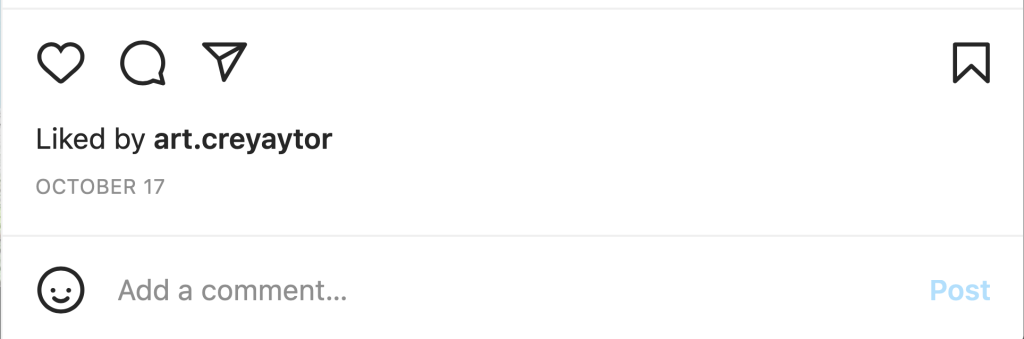
To the end, I feebly fought for attention in an already overcrowded market. I’ve learned that I’m simply not built for this method of projecting. My attempts at redefining my idea were typically phoned in, and have proven that a social media career would not be a sustainable option for me (not that I’ve ever wanted to go down that road).
I like my photos, though.
-
DA Update #2
So far, my digital artefact hasn’t gone as I had imagined. The drive to seek audience engagement has yet to kick in (being an introvert is quite the love/hate relationship story), although I have begun to brainstorm.
My original schedule has been struggling under the weight of my inability to streamline material. I’ve often gone weeks without inspiration, before it all suddenly clicks in and I take a bunch of photos at once. At least I can say I’ve met the deadline.
It turns out, all it really took was for me to take a detour through the Botanic Gardens on my way home for me to suddenly feel the need to snap away. Having a phone is good that way, I guess. It’s at the very least allowed me to indulge in my spontaneity. Plus, this way I don’t have to waste twenty minutes of my life per week pretending I know how to use a tripod.
I believe things have gotten on track with my Twitter account. I’ve gone a little beyond simply stating my opinion by also combining it with a statement on the evolution of *insert here*.
Of course, nothing’s blown up yet, but in terms of milestones, I recently discovered that I’ve achieved one like on my profile!

In other words, my job is done here. I’m an influencer now.
This is like that one time when that kid was celebrating his first subscriber on YouTube right before he was given thousands of them at once.
That’s exactly what’s around my corner.
If there’s one legitimate statement I can make about this milestone, it’s that I’m reaching the demographic I’ve intended – or at least I’m beginning to. The people who follow lifestylesydney typically go there to take a break and look at some pretty pictures, and that is essentially all I’ve been making this whole time.
In terms of moving forward from that unthinkable milestone, I think what I need is a theme per week. I originally was going to go for a different camera technique each week, but then I thought that might get too technical. At this point, I believe I should go for moods. One week could be gloomy vibes; next week would have cheery vibes; the week after, it’s hopeful – all three emotions.
As I’m writing it, it’s beginning to sound a little dumb, but I definitely want a theme each week – that’s all I know for now.
Also, after reading Bev Humphrey’s old article about Instagram (The School Librarian, Vol. 64, Its 4, 2016), I’ve been reminded that hashtags are a thing. Using them would certainly be a good step in improving my audience engagement. I’ll figure out the technicals later.
So far, this project has been one of those things I just feel the need to bottle up inside until I actually take the time to think about it and realise it’s not that hard. I believe that once I start implementing more structure and attempts at connecting, I’ll get there.
Reference
Humphrey, B 2016. Instagram, The School Librarian, Wanborough
-
DA Update #1
The concept of a digital artefact remains one of the most terrifying things I’ve ever heard.
For weeks, I struggled to come up with an idea of what to do with it. This was largely due to the fact that I’ve never found my interests worth sharing (sad, I know). It took some time, but I eventually settled on photography. Since then, I’ve been sharing posts on an Instagram account. My aim has been to do so at least once a week. I made my first crack at posting by finding a few photos that I’d taken already. Here’s an example (and probably my favourite):
So far, I’ve mostly been operating from my comfort zone – which consists of isolation. Due to this, the experience has been pretty relaxing so far. I may have only gotten one viewer that I can count so far, but I think I’ve gotten some decent photos.
My effort into these photos haven’t gone much further than me looking up from where I’m standing/walking and going, “oh, that looks pretty” (direct transcript) and getting my phone out. It’s been less about learning the fine print of photography and more of a soothing personal exercise.
The audience I’ve been aiming to attract consists of people that know as much about photography as I do – in other words, they see it as a casual hobby. This aim hasn’t changed significantly since the beginning of the process, although it has become a tad less ambitious. I’m no longer going out of my way to try to “inspire” people to do photography (although I guess it would be a nice plus)
My presence on Twitter has been fairly aimless so far as well. The motivation to tweet tends to come from random thoughts I have on developments in film and tv. Their relevance week-to-week has been a bit shaky, but I’ve tried to keep them as semi-recent as possible. My first tweet involved my thoughts on Better Call Saul (pretty recent, I guess). I’m hoping that once I get used to using Twitter regularly, I’ll have more to say.
I have the link here:
Moving forward, I hope to become more relaxed. This project is asking me to reach beyond my comfort zone, and I feel I’ve yet to rise to the occasion. This sort of thing usually takes time for me. My plan for now is to continue posting photos and hope for the best. I don’t know how well this method has served me in the past, but I feel I need to ease into this.
-
Everything Instagram has to offer
‘Tis I, the ultimate expert on all things social media. I’m so good, I almost post to Instagram twice a year as opposed to once a year.
On average, my posts are devoid of worth, so in a way I’m being authentic to myself. The few photos I take often consist of me looking up from my phone and thinking “huh, that kind of looks pretty” and that’s it. Every fifteen months I’ll maybe look at something and think, “oh this’ll be hilarious” and then I post it and realise it’s not really.
There’s no intended audience in mind – really no thought at all. I had to analyse my hypothetical audience, I’d argue they care about their image even less than I do.
Despite my mindset, I still see the potential this platform presents for people who do care. Instagram leaves the door open for multiple opportunities. People can share their art, their lives and their thoughts. The lack of emphasis on messaging allows a large chunk of the arguments to take place on Twitter instead (I’m generalising of course, but don’t pretend you can’t tell the difference).
For years, Instagram has allowed us to present whatever sense of self we choose (and in turn has enabled influencers to develop careers – damn it).
The post features have given me the opportunity to express and share my interest in photography (which I’m only doing for uni, but I guess that counts). The chat feature, although less emphasised, has allowed me to contact friends and family on a fairly regular basis. Oftentimes, I find myself scrolling through my feed just to get away from the news and all the controversies; something that wouldn’t be possible on Twitter.
Much like other social media platforms, Instagram allows users the opportunity to share their interests with each other. An example of this can be found through the hashtag – #bookstagram – a hashtag mentioned in a 2016 article that places emphasis on the presence Instagram now has in school libraries in the US. Writer Bev Humphrey also shares her positive experience on the platform, claiming that she had yet to find “any inappropriate or negative comments” (Humphrey, Bev. 2016. Instagram. Vol 64, Iss 4).
Other tasteful hashtags that seem to go around include the throwback Tuesday one (or was it Thursday? It was probably Thursday). Another one to mention would be #love… I can’t imagine there’s too much to pick apart there.
Whilst I refuse to take it seriously in real life, Instagram remains more tolerable than most of the social media platforms I’ve come across (more inviting, at least). As much as I hate the endless amount of creepy Stranger Things-inspired art that pops up in my recommendations, I can’t say it wasn’t my fault – I haven’t searched up much else. Also, I’d much rather receive that than ten more hot takes that aren’t really hot takes (I don’t like Twitter).
My message here is to stay away from relevant news and focus on what doesn’t matter. It’ll solve everything.
References
Humphrey, Bev. 2016. Instagram. Vol 64, Iss 4. Available at: https://www.proquest.com/docview/1860947754?accountid=15112&parentSessionId=1gQu7oREjpotFUTv8%2BbCw0dCpDlhYgR%2FEYwKqwl5pkE%3D&pq-origsite=primo
-
Citizen journalism, yeah or nah?
It’s time… for me to analyse global news reporting like the educated person that I am.
Now, there are those among us (you know who you are) who have decided that they are not fond of what one would refer to as the ‘system’. Those same individuals have taken it upon themselves to broadcast the news. That’s right: citizen journalism!
Social media has allowed imposters (Among Us isn’t relevant anymore, is it?) to run amok. Is it truly an epidemic? Probably not. They’re likely to be super annoying in person, though.
It’s probably been said enough, but we truly don’t deserve the internet (and there are certain sites that prove this only too well). Now, there’s very little need for paper – although I guess the trees aren’t going to cut themselves down, are they? We’ve moved past newspapers and magazines and are now turning to Facebook, Twitter, Google and blogs (please not mine, though). It was through the internet that citizen journalism rose from obscurity and into all our hearts. Scholars have struggled to settle on just one definition for it, but there is one particular article that defines it as “news content produced by non-professionals” (Wall, M. 2015). In film, we would call them guerrilla-style filmmakers, but let’s not assume these people are at that level of pretentiousness.
I’m so glad I didn’t check Wikipedia before writing this.
In fact, the more I read, the more I realise that citizen journalism doesn’t simply consist of someone’s opinion on Andrew Tate. For decades, brave citizens (Batmen, if you will) have attempted to ‘expose the truth’. Events such as the 1988 U.S. presidential election eroded trust in the news media, thus inspiring the common people to share the news themselves. Of course, now that’s just every U.S. election, only now with each and every side of the equation spouting nonsense (I assume – I don’t really pay attention).
The internet component has allowed citizen journalism to simply become journalism. It seems anyone can say anything about anyone at this point. Obviously, there are benefits to this – for not every country is as free as ours or America. There are those who are attempting to share news from war-torn (say it with me) Ukraine who would’ve struggled to do so pre-internet. This form of citizen journalism has allowed those of us situated safely on the other side of the world away from Putin to gain an understanding of what it’s like to be caught within the line of fire. Images and videos taken from the ground level found TikTok and Facebook before certain media organisations could even reach the area (1) – talk about efficiency.
For countries that are lacking a reliable government (which is all of them, but ‘some are worse than others’ I guess), all they seem to need is citizenry (they also need to stop taking themselves seriously, but that’s why I don’t run them). What citizen journalists lack in traditional ethics, they make up for in drawing connection and raising awareness (when it’s not being communicated on Twitter).
References
Wall, M (2015). Citizen Journalism, pp. 797-813. Available at: https://www-tandfonline-com.ezproxy.uow.edu.au/doi/full/10.1080/21670811.2014.1002513
(1) Tsakiris, M. (2022). Ukraine: how social media images from the ground could be affecting our response to the war. The Conversation. Available at: https://theconversation.com/ukraine-how-social-media-images-from-the-ground-could-be-affecting-our-response-to-the-war-178722
-
BCM 114 DA Pitch
I’ve found that when I’m asked to exploit my interests, my brain often closes its shades. It can’t bear to face the possibility/fact that I have no thoughts to share. Not to mention that I also have to consider the requirement to collaborate.
We’ll see how that goes once my breathing returns to normal.
After much inner-deliberating over what to do for my Digital Artefact, I’ve decided to focus less on an interest I’ve already taken advantage of and more on developing one I’ve yet to fully hone in on. I believe that photography fits this description, as it’s something I’ve lightly dabbled in and showed some interest in, but is something I’ve yet to master.
That being said, I don’t aim to master it (though I guess it wouldn’t hurt). My main aim is to see if I can improve my technique. Each week, I will borrow a camera (or use my phone if need be) and post an image to an Instagram account. I will set a specific goal in mind, and I’ll see where that takes me.
At this stage, I intend to maintain my focus on nature photography, as I’ve found that I’m drawn more toward that area. I found a study that discusses how the concept of nature “became essential to the identity of photography during the time of the medium’s conception” (1), which implies that it may not just be me. I suspect that I simply find it soothing. I’m hoping to attract an audience that feels similarly to me.
I figure that a showcase of me slowly improving at something would be at least somewhat compelling – it helps that I can’t think of anything else.
Pitch Link to Instagram profile – https://www.instagram.com/bcm114_jbarron/
Reference
(1) Bull, S. 2009, The Identity Of Photography: Photography, Routledge, p.g. 5, available at https://ebookcentral.proquest.com/lib/uow/reader.action?docID=465444
-
What is popular culture?
I’m back (just as I intended, of course). I know this is an awfully ‘contrarian’ thing to admit, but I prefer high culture over popular culture.
Let’s try this again.
I’m a basic bitch. All I have are popular thoughts. I don’t deserve the purity required to consume high culture.
I’m going back again (I’m not editing any of this).
I guess while I’m here, I should probably define the term ‘popular’ first. Multiple definitions seem to come up. Somewhere it says that popular is ‘well liked by many people’. Elsewhere it refers to ‘inferior kinds of work’. Somewhere else, Storey (2015, pp. 5-12) refers to it as the culture that is ‘left over’…
Do these people think they’re better than the populists? Is this the class struggle Karl Marx wouldn’t shut up about? The messiah that I am is here to give a non-answer to these questions. Instead, I will discuss what makes a medium a piece of popular culture, and I’ll do so respectfully, and you’re going to love it just as much as I will.
For the sake of giving an example, let’s talk about the US version of The Office. I love it. I love the nuanced comedy; I love watching the characters grow. It’s the pure definition of comfort food. It’s also incredibly popular – oh no.
Moving past that, there are multiple signs that point towards the show’s rightful place in popular culture. For one, there’s nothing subversive about the show. It is designed to recreate the mundane 9-5 life, which would mean it was “made for the people” – an acceptable insult if those people are from Mangerton.
Now it’s time for my favourite phrase: let’s get political. A 2015 article had this to say on the melding of popular culture and politics: “There is little doubt that popular culture displays a high level of complicity in the power positioning of traditional political and economic orders” (1). Writers Duncombe and Bleiker continue here: “The political economy of film is intertwined with the needs and desires of political leaders, and yet it also provides the framework within which these needs and desires emerge” (1).
If we were to follow this logic, then it would be pretty easy to refer to The Office as ‘complicit. While it does satirise the general way in which most companies are run, there’s no statement being made about it. What we get instead is a truck-full of character moments and comedy – which is all anyone should need.
So if I were to definitively define what popular culture is, then all I would have to do is combine everything I’ve dived into today. The Office is, like most comedies, a people-pleaser. It’s made by the people with the intention to represent the people. There’s no subversion; no pressing messages to be found about our political climate (not even for 2005). Humour stands amongst the core cultural touchstones. To put it in simplest of terms, it is popular. In other terms, it is basic.
That is all.
References
1983, 237 in Storey, 2015, pp. 5-12
(1) C. Duncombe & R. Bleiker. 2015, ‘Popular Culture and Political Identity’, E-International Relations, http://www.e-ir.info/2015/05/02/popular-culture-and-political-identity/
-
Moral panic surrounding film: justified or irrational? Part 2
To jump sixty years would mean skipping the youth movement of the 1960s-1970s, a time when violence became depicted in a more off-hand way. Thankfully for me, there has been no shortage of moral panic from the 90s onward. The rise of filmmakers such as Quentin Tarantino and David Fincher saw violence and curse words thrown to maximum. The era of edgy kids had yet to abandon us, only by this point their clothing sagged beyond what should be considered normal human capacity. They went to see Pulp Fiction in 1994 and… found their people? I would hope not.
What they hopefully found instead was an endless supply of memorable lines, compelling characters and gripping monologues. According to certain parents, however, the level of violence was simply too much. Depictions of murder, heroin use and rape run rampant. What has often been referred to as ‘gratuitous violence’ quickly became a trademark in Tarantino’s filmography and remains so to this day, prompting endless debate over whether or not his films pose a danger to impressionable minds. Upon Pulp Fiction’s release, even US presidential candidate Bob Dole felt the need to condemn Tarantino as “a purveyor of mindless violence” (1).
When asked, Tarantino always responds similarly: “Whenever there’s a problem in society, blame the playwrights: ‘It’s their fault; it’s the theatre that’s doing it all’” (1). Once, when asked why he insists on implementing gratuitous violence, he responded by proclaiming: “Because it’s so much fun!”.
Despite him clearly intending to create an escape through his use of cartoony violence, there still remains debate surrounding the danger of his films. This debate differs from past moral panics, including the one surrounding the gangster genre. It is one that has fizzled out slowly as onscreen physical violence slowly became accepted to a degree – although it still remains a nuanced debate.
As to whether concerns surrounding film violence are justified or irrational, it turns out I’m not too sure. This was certainly a much broader topic than I thought it would be. I was so ready to go with the irrational route and leave, but without the myriad of evidence I was expecting, it became a complicated question once I reached the 90s.
I attempted to improve upon my pitch by bringing in a clearer focus – by honing in on two periods of moral panic, rather than all of them. Through the blog structure, I hoped to also convey my mindset as I trudged along, building up to an answer I eventually came to realise I don’t have a definitive grasp on.
In short, I’m never going into politics with these debating skills.
Bibliography
Drew, C. 2022. “17 Famous Moral Panic Examples (2022)” HelpfulProfessor.com, 2 Apr https://helpfulprofessor.com/moral-panic-examples/embed/#?secret=DYeVpVhFV5#?secret=ZWFFeEGJIC
Jones, E. “Joker and the Long History of Movie Moral Panics” JACOBIN https://www.jacobinmag.com/2019/09/joker-and-the-long-history-of-movie-moral-panics
(1) Doyle, J. 2014. When ‘Pulp Fiction’ Bloodied American Cinema, OZY, 10 Oct https://www.ozy.com/true-and-stories/when-pulp-fiction-bloodied-american-cinema/35295/
Reinberg, S. 2019. Movie Violence Doesn’t Make Kids Violent, Study Finds, Health Day, 18 Jan https://consumer.healthday.com/public-health-information-30/violence-health-news-787/movie-violence-doesn-t-make-kids-violent-study-finds-741747.html
-
Moral panic surrounding film: justified or irrational? Part 1
The real question here is: are the boomers correct?
Well of course, I really just want to say no and end it there, but ‘apparently’ that isn’t well-rounded enough. In the words of every piece of feedback I’ve ever been given: let’s go into more detail.
Old people have been emotionally scarred by fictional stories since the dawn of filmmaking. It always seems to revolve around violence, no matter if the film is actually violent or not.
Let’s try this again.
Moral panic has presented itself in countless forms – dating as far back as the Salem Witch Trials (I guess I could’ve gone further toward the Jesus route, but that’s a whole other can of worms). There’s always been levels to it, but it typically shakes down as follows:
- Concern – an event occurs that sparks social anxiety.
- Hostility – a subculture is seen as ‘folk devils’ who are looked upon with hostility.
- Consensus – fear of this subculture becomes the dominant narrative in media and social discussion.
- Disproportionality – The threat is exaggerated
- Volatility – A moral panic emerges and disappears suddenly (often when another moral panic takes its place)
This theory was taken directly from Goode and Ben-Yehuda’s book MORAL PANICS: Culture, Politics and Social Construction (1). The sheer accuracy of the theory proves that the circle of life really does exist – thank you Disney.
This past century has seen vast periods of moral panic spread surrounding the release of films deemed unsuitable or even dangerous for young audiences. You’ll soon find that many of these periods measure up with Goode and Ben-Yehuda’s theory, but as I’ve already stated: there’s levels to it.
In his 1998 book – Censoring Hollywood: Youth, Moral Panic and Crime/Gangster Movies of the 1930s, John Springhall surmises that “whatever amuses the young for a price but does not appear to elevate public taste will invite middle-class criticism” (2). As cliche as this sentiment sounds, it will prove to ring true, and even justified in parts (but hopefully it’s mostly irrational).
If we were to go all the way back to the beginning, then I guess I’ll start with the rise of the gangster genre.
Believe it or not, there was a period of history in which the edgy kids in town only had middle-aged white men in suits and fedoras to identify with (desperate times). For the sake of taking this topic seriously, here is where I’ll implement more of Springhall’s opinion on the topic, for he claims in his book that “the film industry’s love affair with members of criminal gangs was only natural, they were colourful, violent, and charismatic men and women, whose law-breaking activities were followed by millions of law-abiding Americans” (2). Of course, the older generation took a dislike to this “love affair”. Films such as Underworld(1927) were accused of romanticising the gangster characters by presenting them as the “logical hero(es)”, “a rags-to-riches success story fuelled by the dreams of audiences across the country” (3). Springhall notes that “many respectable citizens believed that (these) films led to an increase in juvenile delinquency”, so they “accused Hollywood of delivering impressionable youth into a career of crime” (2).
Now, was this justified, or was this irrational? It’s probably complicated.
Ultimately, Hollywood took the ‘justified’ route at the time by essentially hiring a janitor in the form of a notable conservative called William Harrison Hays. He assisted in monitoring new releases and promoting ‘Christian values’. His code was put in place to prevent murder from being presented in a way that “will inspire imitation” (2). Of course, this code didn’t work for long, but was there truly any need for it?
Believe it or not, there was evidence to suggest justification, whether any of it was tangible or not is a whole other question. One interesting piece would include the arrest of 17-year-old Joseph Wilkinson for armed robbery. The judge was allegedly convinced that this act was inspired by crimes depicted on film. Wilkinson apparently claimed otherwise – he claimed that a film like Little Caesar (1931 Al Capone-inspired crime film) “would make him want to stopbefore he was gunned down like Edward G. Robinson’s character”. He instead blamed his actions on his parentage (2).
So in the end, it wasn’t so tangible after all. In fact, signs point to this arrest representing both sides of the argument. It feeds into the idea that the parentsare actually the ones to blame rather than the ‘edgy’ films their kids like. I guess that takes away the complication?
Like most moral panics, this one fizzled down over time. Protests came and went (the usual stuff), with parents believing that cinema was to blame for their monstrous children dying away by the end of the 1930s (Richards, The Age 69). In other words, it ceased to be “the dominant narrative in media and social discussion” (1). The interwar period finally regained its status as the interwar period. Gangster and mafia films continue to thrive in our current era thanks to impeccable work by filmmakers such as Martin Scorsese. However, old peoples’ need for us to ‘think of the children’ is a collective one that has and will probably never die down. This need has come in all shapes and sizes, providing an endless supply of material for me to write about. With that being said, I’m jumping to the 1990s next (because I’ve decided that five weeks isn’t enough time for me).
Academic Readings & Bibliography
(1) Goode, E. Ben-Yehuda, N. (1994). MORAL PANICS: Culture, Politics, and Social Construction, State University of New York, The Hebrew University of Jerusalem
(2) Springhall, J (1998) Censoring Hollywood: Youth, moral panic and crime/gangster movies of the 1930s, Journal of Popular Culture; Oxford Vol. 32, Iss. 3
(3) Film Reference, http://www.filmreference.com/encyclopedia/Criticism-Ideology/Gangster-Films-FROM-NOBLE-SAVAGE-TO-SOCIAL-PROBLEM.html
Dinh, V. 2020. The Legacy of Martin Scorsese: From Raging Bull to The Wolf of Wall Street https://www.nyucommclub.com/content/2020/12/19/the-legacy-of-martin-scorsese-from-raging-bull-to-the-wolf-of-wall-street, commonclub, 19 Dec


-
Subscribe
Subscribed
Already have a WordPress.com account? Log in now.
 Joseph's Media Blog